

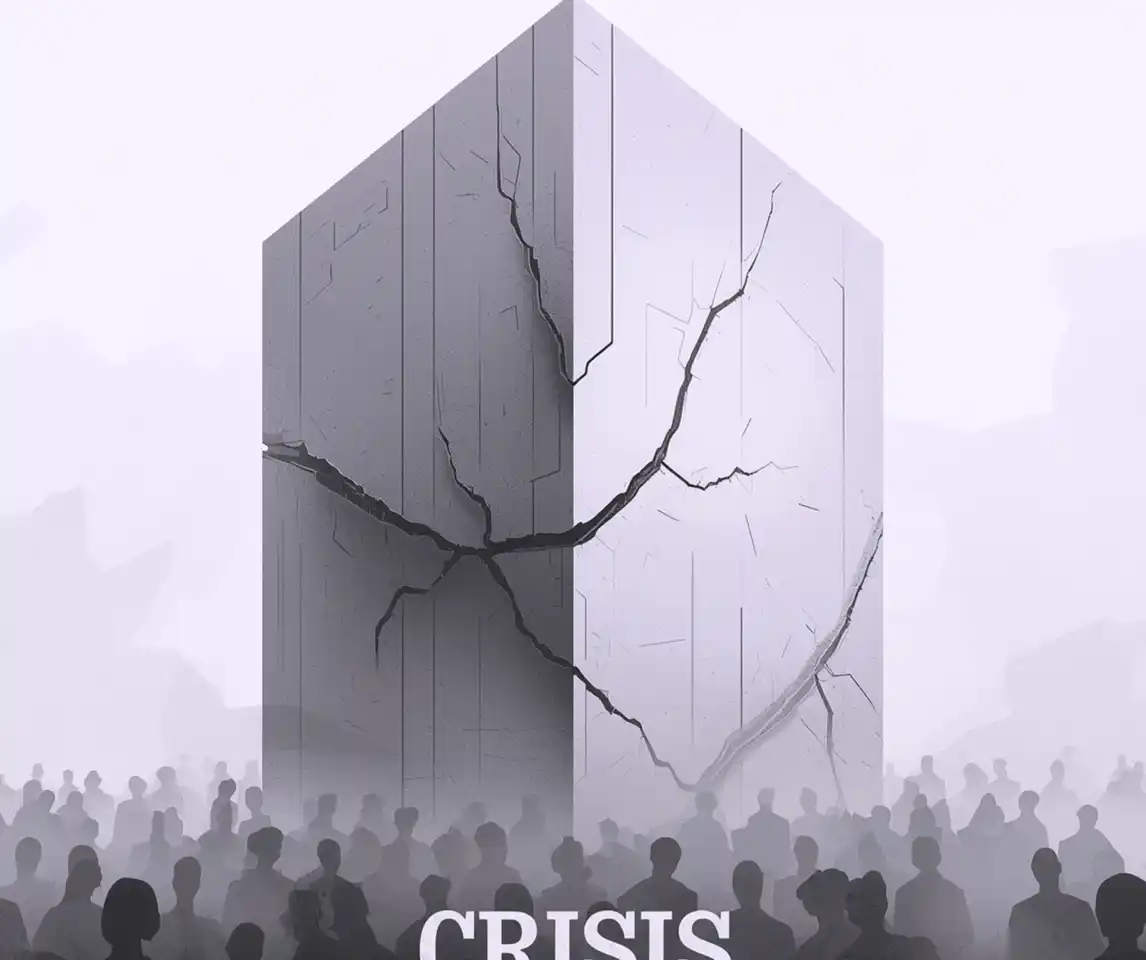


In moments of crisis, organisations often ask the same question: how do we respond?
The answers tend to be familiar. Activate safeguarding protocols. Issue guidance. Expand wellbeing provision. Coordinate through formal structures.
Yet what we see repeatedly — across different contexts, sectors, and scales — is that these responses, while necessary, are rarely sufficient.
This is not because organisations are unwilling to act. It is because many of the systems they rely on are not designed for disruption.
The problem is not capacity. It is orientation.
Most institutional responses to crisis are built on a set of underlying assumptions:
- that needs can be anticipated and categorised
- that support can be delivered through formal channels
- that coordination requires centralisation
- that accountability is achieved through procedure
These assumptions hold under conditions of relative stability. They begin to fracture under pressure.
In crisis, needs are fluid, uneven, and often invisible to formal systems. People do not experience disruption in the same way, or at the same time. Information is partial. Trust is strained.
Under these conditions, systems that prioritise control, compliance, and predictability struggle to respond meaningfully.
The issue is not that institutions do too little. It is that they often act through the wrong logic.
What becomes visible in moments of disruption
Crisis does not only expose vulnerability. It also reveals where capacity actually sits.
Across contexts, what emerges consistently is that the most immediate and responsive forms of support are not institutional.
They are:
- informal networks between colleagues
- mutual support within teams and communities
- acts of care organised without permission or structure
- shared belief systems that enable people to endure and act
These forms of response are rarely recognised as “systems”. They are often described as spontaneous, improvised, or temporary.
But they are neither accidental nor secondary.
They are the infrastructure of collective care.
In many cases, they respond more quickly, more appropriately, and with greater sensitivity than formal mechanisms .
The limits of institutional imagination
There is a persistent tendency — particularly within formal organisations — to treat crisis response as a technical challenge.
This leads to predictable solutions:
more tools, more coordination mechanisms, more frameworks.
But this framing narrows what can be seen.
It sidelines forms of care and organisation that do not fit within institutional categories. It privileges scale over proximity, visibility over effectiveness, and structure over relationship.
The risk is not only inefficiency. It is misrecognition.
When organisations fail to recognise where meaningful response is already happening, they may:
- overlook existing capacities
- duplicate or disrupt local responses
- impose inappropriate solutions
- unintentionally cause harm
This is not a failure of intent. It is a failure of orientation.
Care is not a service. It is a relation.
One of the most consistent insights from crisis contexts is that care cannot be reduced to provision.
It is not simply something that is delivered from one actor to another.
Rather, care operates through:
- trust
- proximity
- shared responsibility
- social and cultural knowledge
- collective meaning-making
This is why responses grounded in relationships — even when resource-constrained — often prove more effective than those delivered through formal systems alone.
It is also why attempts to formalise or scale care without attending to these dynamics tend to fall short.
The issue is not that institutions should withdraw. It is that they must understand their limits.
Rethinking responsibility in organisations
For organisations, this raises a more difficult question.
Not how do we provide care?
But what does it mean to be responsible in conditions where our systems are insufficient?
A more grounded response begins with a shift in orientation:
1. From delivery to recognition
Recognising where care already exists — and ensuring organisational actions do not undermine it.
2. From control to responsiveness
Allowing for decentralised, context-specific decision-making rather than enforcing uniform approaches.
3. From procedure to relational accountability
Understanding accountability not only as compliance, but as responsibility to people, relationships, and consequences.
4. From visibility to effectiveness
Valuing responses that work, even when they are informal, small-scale, or difficult to measure.
5. From institutional centrality to plurality
Accepting that organisations are not — and should not be — the sole actors in crisis response.
A different starting point
Crisis unsettles institutional authority. It exposes where systems are fragile, and where they are overextended.
But it also offers a different entry point for thinking about care, responsibility, and organisation.
Rather than asking how to extend existing systems, organisations might ask:
- What are we not seeing because of how we define response?
- Where are we assuming authority that we do not, in practice, hold?
- What would it mean to act in ways that strengthen — rather than replace — collective care?
These are not operational questions. They are ethical ones.
Closing reflection
The language of crisis response often centres institutions: their plans, their capacities, their coordination.
But crisis itself recentres something else.
It recentres people — and the relationships that sustain them.
This matters because it challenges a foundational assumption: that organised response must always be institutional.
It suggests instead that in moments of disruption, what sustains life is not only what organisations do.
It is what people are already able to do for each other — often despite the systems around them.
How CTDC supports organisations in crisis contexts
Across its work, CTDC supports organisations operating in complex, unequal, and politically charged environments — particularly where standard approaches to safeguarding, care, and response prove insufficient.
This includes:
- diagnosing how organisational systems function under pressure
- identifying where institutional responses may be misaligned with lived realities
- strengthening approaches to safeguarding through relational accountability
- supporting leadership to make ethically grounded decisions in uncertain conditions
CTDC’s work does not begin with solutions.
It begins with how organisations understand responsibility — and what they are prepared to change when their systems are no longer enough.
Reach to Us
Have questions or want to collaborate? We'd love to hear from you.